

Myopia Management
Myopia is blurry long-distance vision, often called “short-sighted’’ or “near-sighted”. A person with myopia can see clearly up close – when reading a book or looking at a phone – but words and objects look fuzzy on a blackboard, on television or when driving.
But a pair of glasses aren't the whole story.
The prevalence among Australian 12 year olds has doubled in 6 years. Myopia in kids tends to progress or get worse throughout childhood, and higher levels of myopia are associated with higher eye disease risks in adulthood.
Signs of Myopia or Nearsightedness
-

Distance vision becomes blurry
-

Moving closer to the TV
-

Reduced performance at school
-

Complaints of headaches or tired eyes
-

Squinting or screwing eyes up
What causes myopia?
Both genetic and lifestyle factors can contribute to the risk of your child developing myopia.

What are the dangers of myopia?
For children, the main difficulty occurs when looking at the board at school and being able to keep up with school work. Glasses can cause a hindrance to sports and 40% of children report that they feel uncomfortable wearing glasses.
However, the biggest risk comes much later. Adults who are myopic have a much higher risk of blindness. For those who have high myopia (over -5.00), there is over 20 times more likely to have a sight-threatening disease (retinal detachment, myopic macular degeneration or cataract) compared to a person who is not myopic.

What should you be doing to help your child?
-
Children are spending less time outdoors than before. Being outdoors, in the presence of bright natural sunlight helps to protect the eyes from developing myopia. A child should be spending at least 90 mins a day outdoors and they will still receive the protective benefits even if they are fully sun smart (i.e. hat, sun cream, sunglasses)
-
The research shows that the increased effort required when reading material is held too close can increase the amount of myopia. The distance between your child’s knuckle and the elbow (the Harmon distance), is the same distance they should be holding a book.
-
It is vital to take breaks from lots of near work and look to the distance. The easiest thing to remember is 20/20/20. Focus on an object at least 20 feet away for 20 seconds every 20 minutes. Taking a 10-15-minute break every 50 minutes also helps to improve concentration as well as helping muscles of the eye.
-
There is now a lot of scientific research, studies and treatments that show the progression of myopia can be slowed substantially. Eyes@Optometry are proud to be on the forefront of the treatments available and our practice offers reliable, safe and proven treatment options for myopia control. Call us now for more information about how to protect your child’s sight.


Diagnosis
Early diagnosis is essential to the correct treatment plan for myopia. Treating it early can slow its progression, reducing the potential risk of developing future eye health issues.
It is important to have your child’s eyes examined regularly. When they start primary school and then every 2 years is recommended.
Treatment Options
Eyes@Optometry are proud to be on the forefront of the treatments available and our practices offer reliable, evidence base advice and treatment options for myopia control.
We have a range of treatments that are available.

Mi Sight Soft Daily Disposable Contact Lenses
Mi Sight contact lenses have a special optical design that allows children to see clearly while slowing down myopia progression by more than half! (Possibly up to 72% when worn as directed).
Our Myopia Management System is a holistic approach to minimizing the progression of myopia by combining Mi Sight contact lenses and lifestyle strategies for better eye health.
Reduces the chance of developing high levels of myopia (-6.00D or more) which may lower the incidence of eye diseases associated with short-sightedness such as retinal detachment and glaucoma.
May improve the self-esteem of children and teenagers in terms of their ability to participate in sporting activities and their social acceptance.
Daily disposable lenses mean there’s no cleaning, disinfection or worrying about lost lenses.
Low dehydration rates, delivers suitable oxygen transmission for daily wear and provide good all-day comfort and eye health.
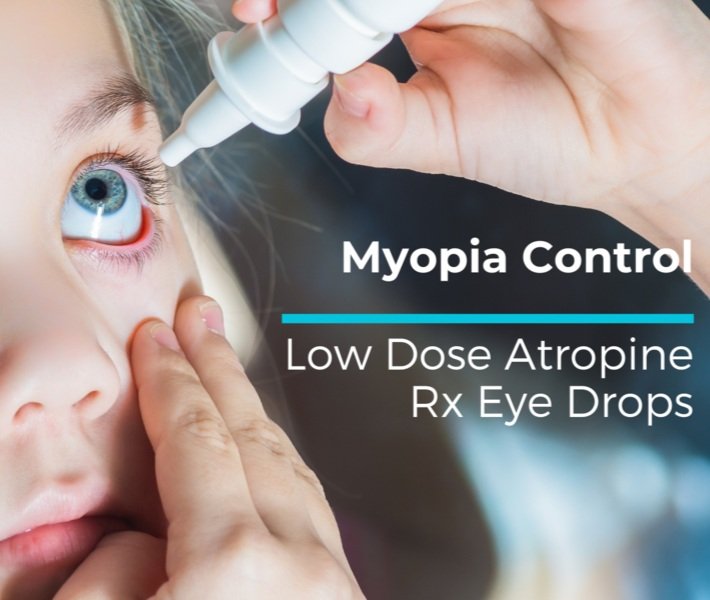
ATROPINE Eye Drops to reduce Myopia Progression
Using low dose Atropine Eye drops once a day, at night time, has been shown to slow down the progression of childhood Myopia by around 50% when used as directed. (13)(14) These eye drops are a convenient treatment choice if your child is not yet ready for contact lenses, or Myopia reducing spectacles are not an option. They must continue to wear their everyday distance glasses while undertaking Atropine treatment, so they have clear comfortable vision.
Your Optometrist will write a prescription for the Atropine Eye Drops, which you can take to your chemist to fill. Occasionally these drops need to be produced by a Compounding Chemist and we can help to organize this. Low dose Atropine has minimal effects on pupil size, accommodation, and near vision and appears to be well tolerated by patients. When initiating Atropine treatment, we schedule a review appt the day after commencing the drops, then at 1 week, 3 months and 6-month intervals to check your child is comfortable. In the long term 6 monthly reviews are advised.
How do Atropine Eye drops slow down Myopia Progression?
Atropine works by blocking the chemical acetylcholine, which relaxes the ciliary muscle of the eye and causes the pupil to dilate. This acts to reduce the axial elongation or “growth” of the eyeball, which in turn slows down the progression of myopia.
Orthokeratology
Orthokeratology (Ortho-K) is a way of temporarily reversing myopia by using specially designed, oxygen permeable rigid contact lenses that temporarily reshape the cornea while the wearer sleeps. After removing the lenses in the morning, vision is generally corrected to 20/20 without the need for glasses or contact lenses during the day.
Over time, clinicians observed that myopic children using OrthoK contact lenses were not progressing as quickly as those wearing standard types of correction, like distance spectacles or soft contact lenses. Several Studies have now shown that wearing OrthoK contact lenses can successfully reduce the rate of myopia progression in school aged children by 45%(13)
How do they work
Ortho-k induces peripheral myopic defocus along the horizontal and vertical meridians.(15) This increased myopic defocus along with reduced peripheral hyperopic blur leads to a decreased stimulus for eye growth, thus halting myopia progression. While each lens design has its unique parameters, commonly shared features of commercially available ortho-k lenses include the following: a larger diameter, small treatment zone (optic zone), and a secondary or reverse curve steeper than the base curve.
Ortho K lenses need to be fitted by a qualified Optometrist. Utilizing state of the art technology they will take baseline measurements to assess your child’s suitability for this myopia treatment. After the initial assessment your Optometrist will create a custom Ortho K Lens that is worn only at night time. A schedule of regular review appointments will also be made to ensure your child has comfortable, clear vision and to ensure the treatment is working successfully.

ZEISS MyoCare lenses
ZEISS MyoCare lenses are designed to slow the progression of myopia in children, offering a tailored approach based on their unique needs. With more than a decade of innovation and research, ZEISS MyoCare provides effective solutions to protect your child’s vision while ensuring clarity and comfort for daily use.
These advanced lenses incorporate ZEISS ClearFocus technology to maintain myopia defocus across all gaze directions, supporting better visual performance. Whether it's the MyoCare lens for younger children with rapid progression or the MyoCare S lens for older children with slower progression, each design is optimised for wearability and effectiveness. Give your child the best outlook on life with ZEISS MyoCare lenses.
FAQ
-
Children from the age of 6 are suitable to be wearing contact lenses
-
This is easy. We offer a free comfort trial when your child has an eye test with us. This means we’ll apply the lens to their eyes and see how they find them. As long your child is comfortable, we perform an assessment and consultation to ensure the fitting is good and then we will make an appointment to teach them how to handle the lenses. This includes looking after them and applying and removing the lens. As part of the consultation, we give you a week’s supply of the lenses to use at home and school. We perform final checks at the end of the trial week to make sure your child is 100% happy and that the lenses are safe for your child to wear.
-
Research has found that there is an area of blurry vision in the periphery of our vision that drives extra growth in the eyeball. This leads to the progression of myopia. When you are short-sighted, this area of vision is one of the factors responsible for the changes. It doesn’t matter if you wear your glasses or not, the vision can still get worse. The myopia control contact lenses change in the vision in the periphery while still keeping the central vision clear. This suppresses the additional lengthening of the eyeball thus reducing the rate of change.
-
These techniques and contact lenses have been development for over 10 years. There have been published studies that have followed children for over 4 years while wearing these lenses (12). The children in these studies responded very well to lenses and about 40% of the kids demonstrated no clinically significant increase in short-sightedness over 3 years. The other 60% of participants progressed by only -0.75DS over the 3 year study period which is HALF the expected myopic progression rate compared to untreated children.
-
They are single use (daily) so every lens they wear is sterile and clean before insertion. The risk of an infection is minimal, when used as directed, and often young children as young as 6 can be responsible for washing their hands and looking after the lenses. In fact, the risk of infections is often shown to be lower in children then adults. For reassurance, we offer unlimited emergency appointments if ever there is a concern.
-
YES and we teach them and you how to do it.
-
The myopia control works best when a child wears lenses at least 10 hours a day, they can wear them longer. The lenses need to be worn at least 6 days a week for maximum myopia control. The myopia control contact lenses will need to continue to be worn until they are around 18 or have had NO change in prescription for 2 years. Many children will continue to wear normal contact lenses after the treatment as they are convenient and provide clear vision.
-
Yes, it would be a good idea for them to have a pair of glasses to wear for 1 day a week.
-
Step 1 – book your child in for an eye exam to assess their vision and suitability (30 mins)
Step 2 – appointment 2 will be a fitting and instruction for contact lenses (allow 1 hour)
Step 3 – after 1 week of wear we will see your child again to assess fit, comfort and vision
Step 4 – order 3 or 6 month supply of lenses
Step 5 – 6 monthly appointments to assess vision and myopia progression (30 mins)

Ready to Prioritise Your Eye Health?
Book your eye examination today and experience personalised, professional care with the latest technology. Whether it’s a routine check-up or specialised assessment, our team is here to help. Call us now to schedule your appointment or book online for your convenience. Don’t wait—clear, healthy vision starts here.